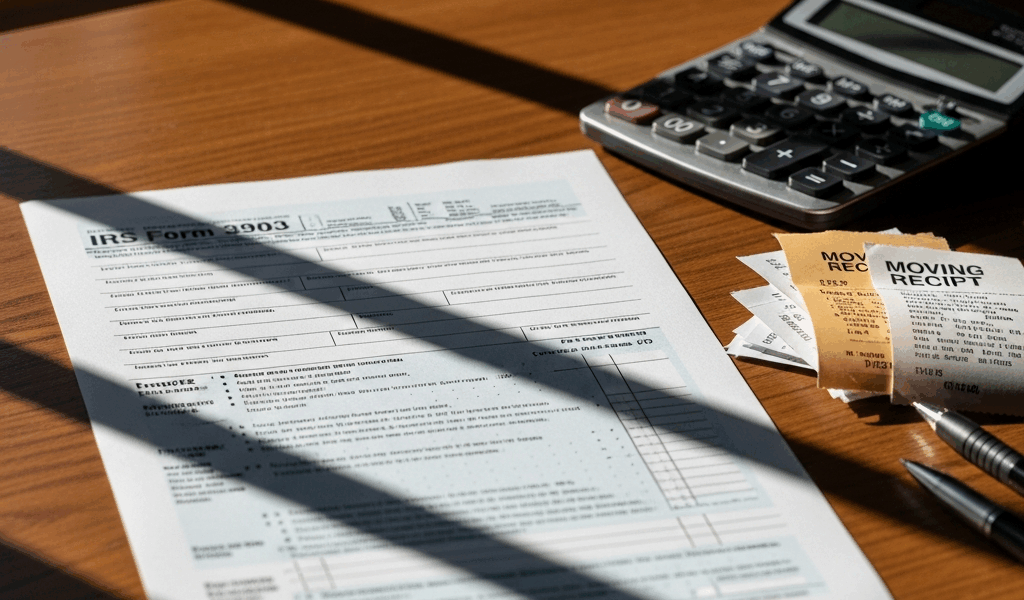
Military PCS Deductions Have Gotten Complicated With All the Misinformation Flying Around
As someone who survived two PCS moves before finally hiring a CPA, I learned everything there is to know about what the IRS actually allows — and what gets you audited. Today, I will share it all with you.
But what is a deductible PCS expense, exactly? In essence, it’s a qualifying cost that the government didn’t already reimburse you for tax-free. But it’s much more than that — the rules around what counts, what doesn’t, and how the math works have tripped up thousands of service members who filed confidently and filed wrong.
What’s Deductible in 2026 — The Short List
Only active duty service members on official PCS orders qualify here. Full stop. The IRS allows three things: transporting your household goods to the new duty station, reasonable lodging and travel costs getting yourself there — no meals, not one — and storage costs for your belongings while they’re in transit. That’s the list. Anything the government already reimbursed you for and excluded from your taxable income? Off the table entirely.
I learned this the hard way. After my second PCS, I confidently listed every single expense — meals during the drive, a real estate agent’s commission from selling my old house, all of it. The CPA I hired after the fact walked me through what actually counted. That conversation saved me from an audit that could have cost thousands. Don’t make my mistake.
The Reimbursement Math That Confuses Everyone
Here’s the thing most service members get wrong immediately. The IRS doesn’t care about your gross moving expenses. What matters is the gap — the difference between what you actually spent and what the government paid you. Uncle Sam covered it? You don’t get to deduct it again.
So, without further ado, let’s dive in — starting with the three main reimbursement streams.
DLA — Dislocation Allowance
Say you receive a $5,000 DLA as a tax-free allowance. Your actual household goods transportation cost: $5,800. Your deductible amount is $800. That’s it. The $5,000 doesn’t shrink your deduction — it eliminates the first $5,000 of eligible expenses entirely.
Flip the numbers. Your DLA is $5,000, but you only spent $4,500 moving your stuff. Zero deduction. Worse, you might owe tax on $500 of that DLA because it exceeded your actual qualifying expenses — depending on how your command processed it.
MALT — Miscellaneous Allowance for Logistics and Travel
MALT covers specific costs — temporary lodging, some travel expenses en route. Unlike DLA, it’s tied to actual line items. If MALT paid you $1,200 for lodging at a Marriott near your new base and your actual room bill was $1,400, you deduct $200. Bill was $1,000? You deduct nothing. You also don’t report income on the unused $200. That surprises people.
TLE — Temporary Lodging Expense
TLE is the trickiest one — honestly. It reimburses lodging near your new duty station while you’re settling in, often covering up to 60 days. Hotels, apartment deposits, utilities while you find permanent housing. None of those are moving expenses under Form 3903. TLE doesn’t reduce your Form 3903 deduction because it’s reimbursement for living expenses during the transition, not moving expenses. Two completely different buckets.
This is where I see service members make a critical error. They assume TLE limits their deduction somehow. It doesn’t. That’s what makes TLE so endearing to us — when you understand it correctly, it’s essentially free money that doesn’t cost you a deduction.
Form 3903 — Line by Line
Probably should have opened with this section, honestly. The form itself is simple — five lines — but every single one demands accuracy.
Line 1 — Transportation of Household Goods and Personal Effects
Enter the total the moving company charged you: packing, loading, shipping, unloading, storage-in-transit costs beyond what the government covered. Say a mover charged you $4,200 to ship 14,000 pounds from Fort Bragg to Fort Hood. The government’s negotiated rate maxed out at $3,800. You put $4,200 on Line 1. The reimbursement math comes later, on Line 4 — not here.
Line 2 — Travel and Lodging While en Route to Your New Home
Airfare, rental car, gas, tolls, hotel rooms, parking — while you’re physically moving. Not meals. A cross-country drive from North Carolina to Texas? Hotel bill goes here. The $180 you spent at Chipotle and Cracker Barrel does not. If you flew instead and paid $320 for two nights at a Holiday Inn Express near Fort Sam Houston, that’s $320 on Line 2. Lodging for your spouse counts. Lodging for your kids counts. Your family dog’s kennel stay is a separate conversation — and yes, it actually comes up.
Line 3 — Total of Lines 1 and 2
Add them up. E-7 example: Line 1 is $4,200 in household goods. Line 2 is $840 — two hotel nights at $420 each. Line 3 is $5,040.
Line 4 — Enter the Amount Your Employer Reimbursed You
This is where the math matters. Every cent the military paid you for moving expenses that you excluded from income goes here. DLA was $5,000? Base paid $1,000 directly to the mover and excluded it from your LES? You’re writing $6,000 on Line 4 — even if you only spent $5,040 total. Report what they gave you, not what you spent.
Line 5 — Deductible Moving Expenses
Subtract Line 4 from Line 3. Same E-7: $5,040 minus $6,000. Negative number. Your deduction is zero. You cannot claim a loss on moving expenses — that’s not how this works.
Adjust the scenario slightly. Same E-7, but now receives only $4,000 DLA plus $200 MALT, and the base pays the mover $800 directly. Line 4 is $5,000. Line 3 is still $5,040. Line 5 is $40. Claim it. Forty dollars is forty dollars.
5 Expenses You Can Probably Still Deduct
These five categories trip up service members constantly — they’re not obvious line items on a mover’s invoice, but they’re real expenses, they’re documentable, and they legitimately reduce your taxable burden beyond what the government covered.
1. Storage Beyond 90 Days of Government Coverage
The military covers storage for household goods in transit — typically 90 days maximum. Base housing not ready? Waiting for your family to join you? If you pay a storage facility an extra $800 for months four and five, that $800 is deductible. Keep the facility receipt, your original move paperwork showing when transit storage ended, and the storage bill showing exact dates covered. The IRS will ask for all three in an audit.
2. Lodging Beyond Per Diem When Your Authorized Hotel Is Full
Government-contracted hotel is booked. You stay at the Hilton instead — $180 per night versus the $120 authorized per diem. The extra $60 per night is deductible. Five nights: $300 deduction. Get the hotel folio showing the dates and rate. Get your PCS orders showing the authorized lodging allowance. Together they prove the excess cost cleanly.
3. Vehicle Shipping Above Government Allowance
The military covers shipping one POV. You own two. You ship the second yourself — $1,400 to an auto transport company. That’s fully deductible. Government covered $1,000 of it and you paid $400 out of pocket? Deduct the $400. Get the transport invoice and your DD-1351-2 voucher showing what the government actually paid for vehicle shipment. Both documents, not one.
4. Household Goods Overage Above the 18,000-Pound Cap
Your household goods weigh 19,200 pounds. The government covers 18,000. The mover charges an overage fee of $620 for the extra 1,200 pounds. That $620 is deductible. Don’t try to claim the mover’s full weight-based rate on the entire shipment — wrong approach. You deduct the overage charge only. The invoice will show this explicitly. Make sure it does before you sign anything.
5. Pet Boarding During PCS Travel Days
Your family dog can’t fly in the cabin and your new home isn’t ready. Four days at a kennel — $480 at $120 per day. Deductible. The IRS treats reasonable pet boarding during the physical moving period as a transportation cost. Get the kennel receipt showing the dates and daily rate. This one surprises people every time, but it holds up under audit when your dates align with your hotel receipts from the same travel window.
What’s Definitely Not Deductible
These used to be fair game. They’re not anymore.
- House-hunting trips. The Tax Cuts and Jobs Act of 2017 killed this. Any cost related to traveling to your new duty station before you officially move — scouting neighborhoods, touring houses, meeting real estate agents — gone. Until Congress changes it again, which looks unlikely.
- Meals during travel. Not a single bite. Not the $38 Uber Eats delivery in the hotel room. Not the road trip meals. Meals have been excluded from this deduction since 1986 — that rule hasn’t budged.
- Spousal income loss. Your spouse quit their job to move with you. That income loss is a personal loss — the IRS doesn’t compensate for career disruption. Not a moving expense.
- Real estate fees on your old home sale. Paid a realtor 5% to sell the house before the PCS? That’s a capital transaction. Handle it on Schedule A if you itemize. Not Form 3903 territory.
- Lost security deposits or lease-breaking fees. You broke your apartment lease early. The landlord kept your $1,500 deposit. That’s genuinely awful. Still not deductible — your lease terms caused the loss, not the move itself.
- New furniture or household items. Couch didn’t fit in the truck, bought a new one. Personal purchase. Not a moving expense, full stop.
Documentation You Need to Keep
The IRS audits moving expense claims more aggressively than most deductions — they’re easy to inflate and auditors know it. I’m apparently paranoid about this stuff, and keeping records for seven years works for me while the standard three-year window never feels like enough. Moving expense audits frequently go back further because the IRS suspects systematic overclaiming. Seven years. Not three.
- PCS Orders. Official change of station orders from your command. Digital or paper, doesn’t matter. Without these, everything else falls apart immediately.
- DD-1351-2 Travel Voucher. Your moving reimbursement record from finance — what the government paid you, the dates, what they covered. Request this from your S-1 or finance section the month before you move if you haven’t received it yet. Don’t wait.
- Moving Company Invoices. Everything from the carrier: packing, loading, shipping, unloading, storage-in-transit. Multiple movers? Invoice from each one.
- Hotel Receipts and Folios. The itemized folio — not just a credit card charge. Date, nightly rate, taxes, exact charges. Photograph every folio. Email it to yourself immediately. Don’t trust the paper copy alone.
- Mileage Log. If you drove your own vehicle, log your miles with dates and actual odometer readings. Most service members estimate — don’t. Auditors notice round numbers. You drove 1,847 miles? Write 1,847. Not “approximately 1,800.”
- Bank and Credit Card Statements. Traces where reimbursements landed and what you paid out of pocket. The IRS wants to follow the money both directions.
- Receipts for Overage Items. Storage facility statements showing dates beyond the 90-day government coverage, kennel invoices with matching dates, auto transport invoices — anything proving costs above the standard government coverage level.
What If You’re a Reservist
Probably should have flagged this earlier — this is where I see the biggest missed deduction, period. Reservists called to active duty for more than 90 days can deduct moving expenses to and from the active-duty location. You don’t need permanent change of station orders. You need a call-to-active-duty order specifying the location and showing the tour exceeds 90 days.
The IRS guidance lives in IRC Section 217(g): “In the case of a member of the Armed Forces on active duty… the moving expense deduction shall apply to a move to or from any location.” That language covers reservists and National Guard members activated for extended periods. A 120-day activation? You qualify. A 30-day training rotation? You don’t.
I’ve met E-5 reservists who moved cross-country for their first activation, paid thousands out of pocket, and claimed zero — they assumed only active-duty regulars got the deduction. That’s wrong. Get those orders reissued as a formal moving order from your reserve unit’s S-1, and file an amended return if you missed it in a prior year. That’s recoverable money sitting on the table.
DIY vs. Tax Pro
Here’s my honest take. Deductible moving expenses totaling under $1,000? File it yourself using TurboTax’s military-specific free file version. Twenty minutes. No fee. It walks you through each line of Form 3903 without much friction.
Over $1,000? Overseas move? Two vehicles shipped? Separation coinciding with the PCS? Pay a CPA who specializes in military tax. Budget $200–$400. They catch deductions you’d miss, make sure your documentation is bulletproof, and if the IRS ever sends a letter, they’re your representation — not you alone with a folder of hotel receipts.
The worst outcome I’ve seen: someone claims $6,000 in moving expenses confidently, gets audited, and then discovers they missed $1,500 in legitimate deductions that would have zeroed out the audit entirely. The audit letter alone costs you weeks of stress. The CPA fee is insurance against exactly that scenario — and it usually pays for itself the first time they find something you overlooked.



Leave a Reply