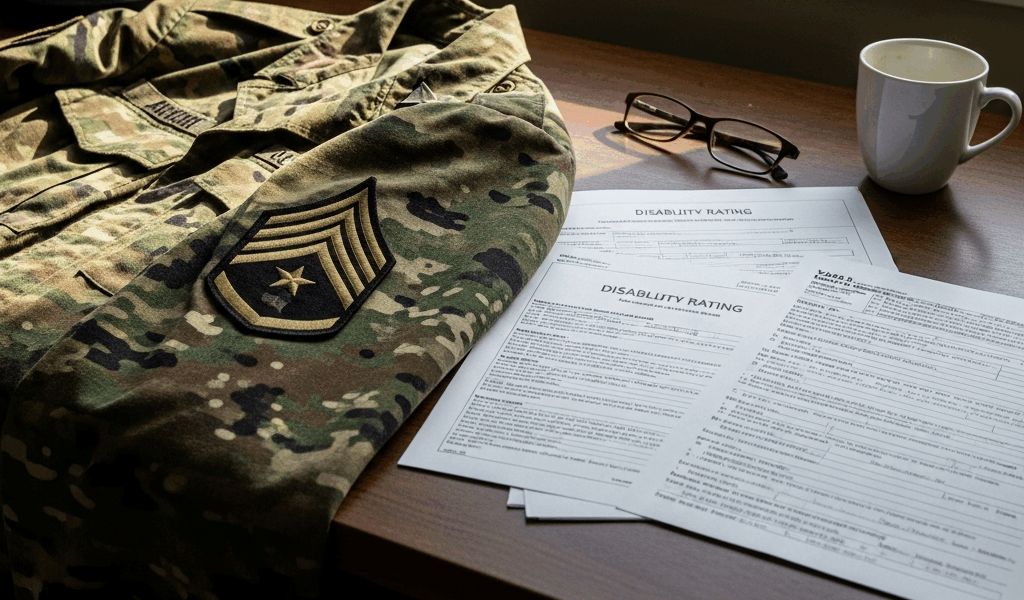
When You Can Actually File for a Rating Increase
VA disability increases have spiraled into something unrecognizable with all the misinformation flying around. As someone who spent three years fighting my own rating battles, I learned everything there is to know about this process. Today, I will share it all with you.
There’s one brutal fact you need to absorb before anything else: the VA will not touch your claim unless you meet specific timing requirements. I learned this the hard way — calling the VA three times in six months, each time getting told I was filing too early. Three calls. Six months. Zero progress.
Two pathways exist for requesting more money. The first is a standard increase claim, filed on VA Form 21-526EZ. The second is a supplemental claim — what you file after the VA has already denied you. These are different animals. Filing the wrong one wastes months you don’t get back.
The One-Year Rule and Why It Matters
If the VA issued a rating decision on your condition within the last year, you cannot file a standard increase claim. Full stop. You wait. The rule exists because the VA assumes conditions don’t shift that fast — even though veterans living with those conditions know they absolutely do.
Once a year has passed from the VA’s decision date — not from when you think it passed, but from the actual date stamped on your rating decision letter — you’re eligible again. File a single day early and they’ll deny it without even glancing at your evidence. That’s not an exaggeration.
But what is a supplemental claim? In essence, it’s a second shot after a denial — provided you bring new evidence the VA never saw the first time around. But it’s much more than that. New evidence means something they literally did not have in front of them during the original decision. An old medical record you forgot to submit. A fresh diagnosis. A buddy statement from someone who witnessed your service. Those count. A VA exam from two months ago does not count as new evidence. The distinction matters enormously.
What “Worsening Condition” Actually Means to the VA
Veterans usually assume worsening means “I feel worse than I did before.” The VA uses a completely different definition. In their language, worsening means your condition now prevents you from doing more activities of daily living than it did at the time of your last rating. Medical standard. Not emotional.
Say you were rated 30% for PTSD three years ago. Same symptoms, but now they’re gutting your ability to hold a job — that’s worsening. The VA measures functional loss, not suffering. Knee pain unchanged but you’ve stopped hiking, stopped driving on highways, stopped attending your kid’s soccer games? That’s the evidence trail the VA wants to see documented.
Filing too soon with no new evidence is a fast track to denial. I filed for an increase eight months after my rating was set — honestly thought I had solid grounds. The VA mailed back a one-paragraph denial saying they saw no new medical evidence to support a change. It stung. I should have waited those extra four months and built a real case instead. Don’t make my mistake.
The Evidence That Actually Moves Your Rating
Evidence is where most increase claims collapse. Not because veterans lack proof — they don’t. The problem is submitting the wrong kind, or submitting it badly.
The VA weighs evidence in roughly this order: private medical opinions, nexus letters from doctors, then buddy statements. A VA exam alone almost never gets you an increase. The VA already has their exams on file. The examiner walks in with your old results sitting right there on the desk. Your job is proving something changed — not repeating what they already know.
Why a Private Nexus Letter Carries Weight
A nexus letter is a statement from a private doctor explaining the medical link between your service and your current condition — or between your service and why things got worse. It is not the same as your treatment notes. Treatment notes say “patient reports neck pain, prescribed Gabapentin 300mg.” A nexus letter says “based on the patient’s military history and current clinical presentation, the cervical spine pain is medically consistent with the whiplash injury sustained in the November 2012 vehicle collision during active duty service.”
Private doctors write stronger nexus letters than VA doctors. They have no stake in the system — no budget to protect, no institutional pressure pulling their conclusions. They state a medical opinion. That’s exactly what the VA respects, precisely because it came from outside their walls. That’s what makes independent medical opinions so valuable to veterans navigating this process.
A nexus letter that actually moves the needle hits four specific marks. First, the doctor’s qualifications — specialty, license number, how long they’ve treated you. Second, a substantive description of your medical records, not just a symptom recap. Third, specific medical reasoning connecting service to your current condition. Fourth, a clear declarative statement: “It is my medical opinion that [condition] is related to [service event]” — or “it is my medical opinion that [condition] has worsened due to [cause].”
Vague nexus letters sink claims. I watched a friend’s claim get denied because his doctor wrote “the veteran’s back pain could be service-connected.” Could be is not a medical opinion — it’s a shrug. The VA needs “probably is” or “more likely than not.” Four words. The difference between approved and denied.
Buddy Statements That Count
Statements from fellow service members carry real weight — but only when they’re specific and dated. Broad statements like “I know he was injured” accomplish nothing. Specific ones do: “In August 2009, I was standing approximately ten feet from PFC Jones when the IED detonated. I watched him get knocked backward into a concrete barrier. He was unconscious for several minutes. When he came around, he was disoriented and immediately complained of neck pain.”
That statement has a date, visual details, and a direct connection to what the VA is evaluating. The buddy should sign it, include military rank and service dates, and provide contact information so the VA can verify if needed. Thirty seconds of extra effort. Potentially thousands of dollars in additional compensation.
How to Fill Out VA Form 21-526EZ Without Sinking Your Claim
Honestly, I should have started here. The VA Form 21-526EZ is short — deceptively short — and that works against you if you rush through it. Form mistakes derail more claims than bad evidence does.
The condition description field is where veterans lose ground fast. Don’t write “PTSD” and move on. Write what that PTSD means functionally: “Service-connected PTSD manifesting as hypervigilance, chronic sleep disturbance, and avoidance of crowds, preventing consistent full-time employment and causing three job losses in twenty-four months.” The VA rates on function. Make the functional loss impossible to ignore from line one.
The treatment history section requires actual dates and actual providers. Seen a therapist through Cigna every two weeks for the last two years? List every visit. Every hospital stay connected to that condition. Blank spaces read to the VA as “this didn’t happen” — they quietly erode your credibility in ways you never see.
One mistake veterans make repeatedly — listing five conditions on a single claim. A PTSD increase, a back pain increase, a hearing loss increase, all on the same 526EZ. The VA treats it as one claim. If they deny one piece, the whole thing gets flagged. File one condition per claim. Takes longer. Evidence stays focused. Odds improve significantly.
What Happens After You Submit and How Long It Takes
After submission, the VA schedules a Compensation & Pension exam — the C&P exam. This is where veterans either cement their case or accidentally torpedo it. Usually one or the other. Rarely anything in between.
A C&P exam is not a doctor’s visit. It’s a legal proceeding wearing a white coat. The examiner asks specific questions about your condition, your symptoms, your functional limitations. They document your answers. A single careless statement — saying you can lift more than you actually can, downplaying symptoms because you’re having a decent day — gets used against you in the rating decision. I’ve seen it happen more times than I can count.
Prepare by pulling your medical records the week before. Know what you’ve told your other doctors. Know your treatment dates. If you told your VA neurologist that migraines hit you three times a week, tell the C&P examiner the same thing. Inconsistency kills ratings — the VA cross-references everything.
Be honest about your worst days, not your average days. Tell the examiner about the morning you couldn’t get out of bed, not the afternoon you managed a grocery run. That’s not coaching yourself to exaggerate — it’s accurately representing the full picture of your condition. Exaggerating or fabricating symptoms is fraud. The VA has investigators. They catch people. Don’t go there.
If the VA schedules your exam for the wrong condition — and this happens — call and correct it immediately. A veteran I knew was examined for a shoulder rating when he’d filed for a knee increase. Didn’t correct it. The VA used that shoulder exam to reduce his shoulder rating instead of evaluating his knee. The damage took eighteen months to undo.
Timeline expectations: a standard increase claim runs 120 to 180 days from submission to decision. A supplemental claim with new evidence runs 60 to 120 days. These aren’t guarantees. I’ve seen both processed in half that time. I’ve also seen both drag twice as long when the VA misplaced a piece of medical evidence. Plan accordingly.
If They Deny You Again, Here Is What to Do Next
Denial is not the end. It’s a choice point. Three options exist — and which one you pick depends entirely on why they denied you.
The Three Appeal Lanes
A Higher-Level Review is a request for a senior VA rater to re-examine your claim using the same evidence you already submitted. You have one year from the denial date to request it. Use this lane if you believe the VA misread your medical records or made a clear rating error. A Senior Rater pulls your file, reviews it, issues a new decision. Runs 120 to 180 days. No new C&P exam unless the rater decides one is necessary.
A Supplemental Claim is your lane when you have evidence the VA never saw the first time around. That buddy statement you obtained after the denial. A new private medical opinion from a specialist. A hospital record from 2018 you forgot to attach. File the supplemental claim, submit the new evidence. The VA will likely schedule another C&P exam. Runs 90 to 120 days typically.
A Board of Veterans Appeals is where you go to argue the law — not just the facts. You submit a statement in support of appeal explaining why the VA’s decision was legally incorrect. The Board takes 365 to 550 days to decide. Slow. But the Board holds authority the regional office simply doesn’t have.
A VA-accredited VSO or accredited attorney can represent you through any of these. VSO representation costs nothing — zero. Accredited attorneys collect a fee only when they win your case, and as of 2024, the VA caps that fee at $6,700. If you’re heading to the Board, seriously consider getting someone in your corner who handles Board cases regularly. The complexity is real.
Your Next Move Today
Pull your most recent VA rating decision letter right now. Check the date. If it’s been more than a year, you’re eligible for a standard increase claim. Less than a year but you have new medical evidence? Start building your supplemental claim file today. Get on the phone with your doctor this week — private doctor if you have one — and ask directly whether they’ll write a nexus letter. Set yourself a two-week deadline. If you’re facing a denial and weighing an appeal, contact your local VSO and ask which lane fits your specific situation. The VA’s timeline doesn’t pause while you figure things out. Move now.




Leave a Reply