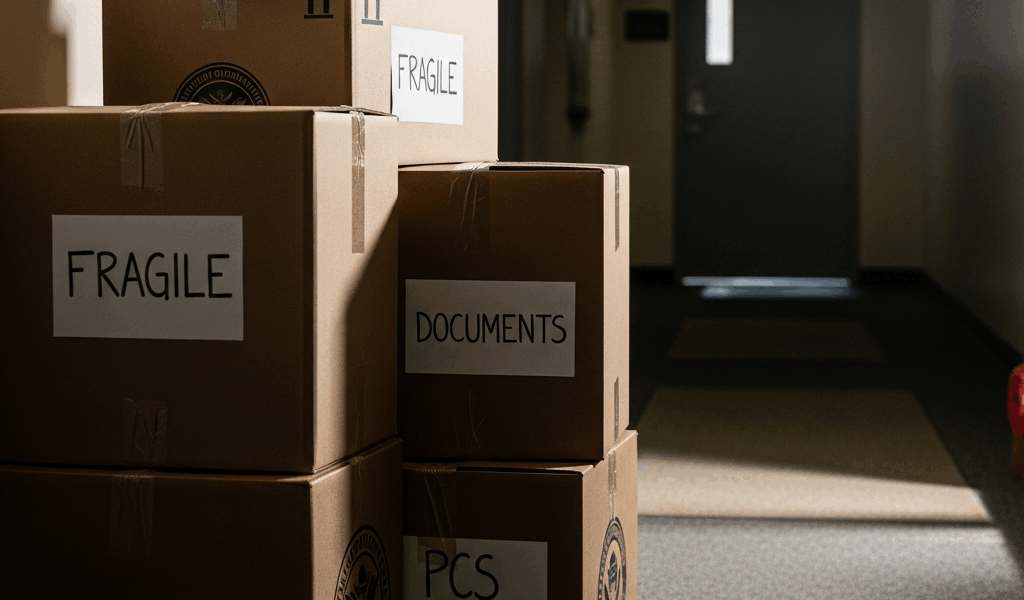
Government PCS Moving Costs — What Gets Covered
PCS moving keeps getting worse, not better with all the conflicting advice, outdated forum posts, and DTMO documentation flying around. As someone who has been through four PCS moves — Fort Bragg to Vicenza, back stateside, then two more CONUS hops — I learned everything there is to know about what the government actually pays for and what quietly lands in your lap. Every single time, I had to relearn the system from scratch. This is what I wish existed before move number one: real numbers, plain sentences, and an honest look at where Uncle Sam’s generosity ends.
What the Government Pays For
There are two main ways the government moves you. A government-arranged move — called a GBL or Household Goods shipment, now managed through the DPS system — or a Personally Procured Move, historically called a DITY. You pick one. Sometimes you split them. But what determines which is right for you? In essence, it comes down to your weight allowance and your willingness to manage the logistics yourself. It’s much more than that, though — the financial implications can swing by thousands of dollars depending on the choice.
Household Goods Shipment — The Full-Service Option
With a GBL move, the government contracts a Transportation Service Provider to pack, load, drive, and deliver your stuff. You pay nothing upfront — the government handles the TSP directly. Your job is showing up on pack days, being present at delivery, and documenting damage. Weight is the hard ceiling. Go over your allowance and you’re paying the overage yourself at TSP rates — which are not cheap.
Weight allowances for a typical service member with dependents:
- E-1 through E-3 — 8,000 lbs
- E-4 — 8,000 lbs
- E-5 through E-6 — 11,000 lbs
- E-7 through E-9 — 13,000 lbs
- O-1 through O-3 — 12,000 lbs (14,500 lbs with 3+ years service at O-3)
- O-4 and above — 17,000 lbs (O-6 and above get 18,000 lbs)
A three-bedroom house worth of furniture and packed boxes runs roughly 7,000 to 9,000 lbs — most families with average households stay within their limit. The problem is always the piano. Apparently it’s always the piano.
Temporary Lodging Expense and Dislocation Allowance
Two other payments matter here — and people routinely leave money on the table by not claiming them properly.
TLE — Temporary Lodging Expense — covers hotel costs during transition at the losing or gaining installation, or both. CONUS TLE is currently capped at $290 per day for a member with dependents, for up to 10 days. That sounds reasonable until you’re stuck in a Hampton Inn outside Fort Campbell for two weeks waiting on housing. Days 11 and beyond? That’s on you.
DLA — Dislocation Allowance — is a flat payment meant to offset the one-time costs of standing up a new household. It’s not based on actual receipts; it’s a fixed amount by pay grade. An E-5 with dependents receives approximately $2,117. An O-4 with dependents gets roughly $4,557. You receive this once per PCS — and it’s taxable income, which catches people completely off guard when January W-2s show up.
PPM Move — How Much You Actually Pocket
Yeah, this is where it gets real. The PPM — Personally Procured Move — is where service members can actually make money on a PCS. Or lose it badly if they miscalculate going in.
Here’s how it works. The government calculates what a TSP shipment would have cost them. They pay you 100% of that calculated amount. You rent the truck, run the move yourself, and keep whatever’s left after expenses. The whole incentive structure was designed to save the government money while giving families a real financial upside. That’s what makes the PPM endearing to us — the rare military policy where the math actually favors the service member.
Real Numbers — E-5 Moving 2,000 Miles
Take a real scenario. Staff Sergeant Rivera, E-5 with dependents, authorized 11,000 lbs, moving from Fort Cavazos to Fort Lewis — roughly 2,000 miles.
The government’s calculated cost for that shipment — the “constructive cost” — comes out to approximately $8,400 to $10,200 depending on current rate tables. The government pays SSG Rivera 100% of that figure.
SSG Rivera’s actual expenses:
- 26-foot Penske truck rental, one-way, with moving kit — approximately $1,850
- Fuel for 2,000 miles in a 26-footer getting about 8 mpg — roughly $600 at $2.40/gallon (about 250 gallons)
- Two nights lodging en route — $240
- Food for the family during transit — $180
- Three friends helping load and unload, paid in pizza and beer — $90
Total expenses: approximately $2,960. Government payment: approximately $9,200 at the mid-range estimate. Amount SSG Rivera keeps after expenses: roughly $6,240. That’s real money — enough to furnish a living room at the new duty station, cover the first month’s utility deposits, and still have breathing room.
Don’t make my mistake. On my second PPM I nearly tanked the entire claim by skipping the certified weight tickets. You need one at origin and one at destination — at a CAT Scale at any truck stop, $13.00 for the first weigh, $3.00 for a reweigh. Without certified weight tickets, your claim gets kicked back and what should take weeks stretches into months.
Hidden Costs the Government Does Not Cover
This section saves marriages. Know these before you touch the DPS system and sign off on your move preferences.
Pet Transport
The government does not pay to move your animals. Not your two Labrador retrievers. Not your cat. Not the fish tank — which TSPs often refuse to move anyway, structural liability issue apparently. Flying two large dogs coast to coast in cargo — Delta Cargo charges roughly $200 to $350 per dog depending on crate size and route — adds up fast. Budget $500 to $700 minimum for two dogs: health certificates ($45 each from a USDA-accredited vet), airline-approved crates ($75 to $150 each if you don’t already own them), and any kennel time during the move gap.
Vehicle Shipping Timing Gaps
The government ships one privately owned vehicle for OCONUS moves. For CONUS moves, they pay mileage via MALT to drive it yourself. Here’s the gap nobody mentions — when you drop a vehicle at the VPC for OCONUS shipping, you typically lose it 30 days before you arrive at the gaining installation. One car household means renting transportation for that entire window. A 30-day compact car rental runs $900 to $1,400. That bill is yours.
Storage Beyond Entitlement
The government covers 90 days of non-temporary storage for specific circumstances — deployment, unaccompanied tours, that kind of thing. Standard PCS gets you storage in transit for up to 90 days if delivery can’t happen immediately, but the authorization paperwork has requirements most people discover after the clock has already started. Days beyond authorized SIT get billed directly to you at commercial rates — currently $150 to $350 per month depending on volume.
Apartment Deposits
DLA is meant to offset this, but in high-cost markets it doesn’t come close. In the Seattle-Tacoma area near JBLM, first month plus last month plus security deposit on a three-bedroom apartment can run $6,000 to $7,500 upfront. DLA for an E-5 is $2,117. The math doesn’t close — not even close. Keep a cash buffer of at least $3,000 to $4,000 for any PCS landing in a high-cost metro.
How to File for Maximum Reimbursement
Frustrated by the move itself, most service members file sloppy claims using crumpled receipts and a prayer, then leave hundreds of dollars uncollected. The system rewards obsessive documentation — full stop.
Receipts to Keep — Everything
For a PPM claim, you need certified weight tickets (both empty and loaded), fuel receipts, the rental agreement, toll records, and packing materials — even the $34.97 roll of stretch wrap from U-Haul counts. Keep every receipt in a single manila folder labeled with your PCS orders number. Photograph them with your phone immediately — thermal receipt paper fades within 60 days sitting in a hot car, and you won’t notice until it matters.
For TLE, you need hotel folios showing the nightly rate and exact dates. Not a credit card statement — the actual folio. Finance will bounce the claim without it. Every time.
DPS System Tips
Log into move.mil early. Accounts lock after inactivity and the CAC-authenticated password reset process has personally eaten around 48 hours of my life across multiple moves. Set up your counseling appointment within 10 days of receiving orders — missing that window doesn’t kill your entitlements, but it compresses your timeline in ways that create real problems later.
For PPM claims specifically — upload documents as PDFs, not JPEGs. JPEG uploads frequently flag for quality review and add 5 to 10 business days to processing. Adobe Scan or Microsoft Lens on your phone creates a clean PDF in about 90 seconds. Free. No excuse to skip it.
Claims Timeline
Submit your PPM claim within 45 days of the last day of authorized travel. Claims after that date need a commanding officer statement of justification and route through a secondary review process stretching to 120 days. The 45-day window starts from the date on your orders — not from when you actually finished unpacking. Mark the deadline on your phone calendar the day orders drop. Straightforward, complete claims typically post within 30 days of submission. Incomplete claims — missing weight tickets, absent receipts, wrong form version — reset that clock entirely and with zero sympathy from the processing office.
Government PCS moving cost management isn’t glamorous. It’s a manila folder, a stack of CAT Scale printouts, fuel receipts from four states, and a DPS portal that times out every 15 minutes like it personally dislikes you. But done right, a long-distance PPM funds the furniture you actually need and builds a buffer against everything the government quietly decided isn’t its problem.



Leave a Reply