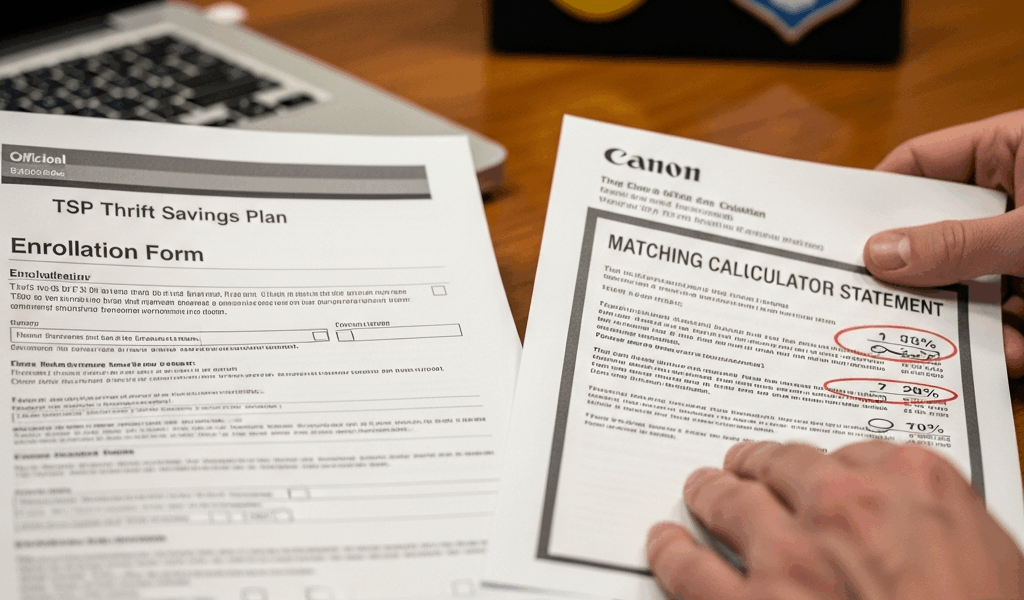
Why Military TSP Matching Confuses So Many Troops
Military retirement benefits have developed a learning curve from hell with all the misinformation flying around. I spent my first two years in uniform genuinely unsure whether I was even getting matched on my TSP contributions. Enrolled during in-processing, picked a contribution percentage, assumed that was the whole story. It wasn’t. I was missing roughly $150 a month in free government money — and had absolutely zero idea.
Today, I’ll share everything I’ve learned about how this actually works. Because nobody handed me a clear explanation on day one, and I’m guessing nobody handed you one either.
The short version: whether you get matched at all depends entirely on which retirement system you’re under. That’s the part people skip. If you entered active duty on or after January 1, 2018, you’re in the Blended Retirement System — BRS. Automatic. No choice involved. If you came in before that date, you were locked into the legacy High-3 system unless you explicitly opted into BRS during the window they offered, which ran roughly 2018 through 2020.
High-3 members get no matching. None. Zero. They get basic TSP access and that’s it. BRS is the only system with employer-style matching, so if you’re High-3, the rest of this article doesn’t change your math — but you should probably confirm which system you’re actually in before assuming anything.
Simply being enrolled in TSP and contributing does not mean you’re capturing the match. Skipping ahead to the part you want. You can be dutifully pulling 5% out of every paycheck and still not be matched — especially if you haven’t hit the two-year mark yet.
When the Government Match Actually Kicks In
The BRS match has two distinct phases. Miss this distinction and you’ll misread your LES for months.
From day 60 of service, the government drops 1% of your basic pay into your TSP automatically. Doesn’t matter if you contribute a single dollar. It just lands there. That automatic 1% belongs to every BRS member from the start.
But the real match — dollar-for-dollar up to 4% of your contributions — doesn’t begin until month 25 of active duty service. Month 25. Not month 24. Not when you pick up rank. Month 25. That’s the number that trips people up constantly.
Picture it: someone enlists in January, finishes basic training around March, checks into their first duty station sometime in April or May. Eight months gone already. They set up TSP contributions around month 4 or 5, contribute faithfully every pay period — and collect only that automatic 1%, because month 25 hasn’t arrived. When it finally does, the matching kicks in from that month forward. Not retroactively to when they started contributing. Just forward.
Missing contributions before month 25 isn’t catastrophic — the automatic 1% kept accumulating either way. But missing contributions at month 25 and beyond? That’s immediate money gone. And it compounds for years.
Here’s the breakdown:
- Months 0–24: Government contributes automatic 1%. You contribute whatever you elect. No match on your contributions yet — just the flat 1%.
- Month 25 onward: Government contributes that automatic 1% plus matches up to 4% of your contributions — 5% total government contribution if you’re putting in 4% or more.
- Contributing less than 4% after month 25 means you get matched on whatever you put in, plus the automatic 1%. You’re just not maxing it.
- Contributing 4% or more after month 25 maxes the match. Five percent total coming from the government, every month.
One more thing worth knowing: the match calculates off basic pay only. Not BAH. Not BAS. Not jump pay or flight pay or any special compensation. Just the base number on your LES.
How to Calculate Your Exact Match Amount
Real numbers help here. Take an E-4 at 26 months of service — basic pay of roughly $2,100 a month, contributing 5% of base pay.
- E-4 base pay: $2,100
- Member contribution at 5%: $105 per month
- Government automatic contribution at 1%: $21 per month
- Government match on the 4% threshold: $84 per month
- Total monthly government contribution: $105
That E-4 pulls in $105 of free money every single month once month 25 hits. Over a standard four-year enlistment, that’s somewhere around $5,000 in government contributions that required nothing but showing up and setting a percentage. I’m apparently an E-4 math fanatic at this point, but the numbers make the point better than anything else.
If that same E-4 had contributed zero dollars during months 0–24, they’d still have the automatic 1% ($21/month) sitting in their account from that period. The moment month 25 arrived, they could flip on the 5% contribution and immediately capture the full 4% match going forward. No catch. No penalty for the slow start.
One ceiling worth mentioning: the IRS caps total annual TSP contributions — yours plus the government’s combined — at $69,000 for 2024. Most enlisted members won’t come close to that number on base pay alone. It becomes relevant mainly if you’re receiving tax-exempt combat zone contributions or have unusual income offsets. Don’t lose sleep over it unless you’re a senior NCO or officer doing the math on a combat deployment year.
What to Do Right Now If You’re Not Sure You’re Getting Matched
Probably should have put this section first. Here’s the fast version.
Log into myPay. Pull up your TSP contribution election. Two things to confirm immediately.
First, check whether you have an actual elected contribution percentage. If that field reads 0%, you’re not getting matched on anything beyond the automatic 1%. The government won’t match money that isn’t there — at least if you’re past month 25. If you’re at zero and past month 25, that’s an immediate fix.
Second, confirm that your election routes to either Traditional TSP or Roth TSP. TSP matching only applies to TSP accounts. Not brokerage accounts. Not mutual funds a financial advisor sold you at the PX. Just TSP. Don’t make my mistake of assuming any investment account counts.
Next, pull your most recent Leave and Earnings Statement. Find the deductions section — look for a line labeled “TSP” with a dollar amount next to it. That’s your contribution leaving your paycheck. Cross-reference the dollar amount against your myPay election percentage. The math should roughly match your base pay multiplied by your contribution percentage. If it doesn’t, something’s off and finance needs to hear about it.
Past month 25 with a 0% contribution rate? Go to tsp.gov right now and update the election. Same-day changes process in most cases — at least if your next pay period hasn’t closed yet. Or walk into your finance office. Either works.
Between months 1 and 24 and not contributing? You’re not losing match money yet. But start contributing anyway. The automatic 1% is fine. Four or five percent gets you positioned to capture the full match the moment you cross into month 25 — without any delay or adjustment required.
Common Mistakes That Cost Troops Real Match Money
Waiting until a PCS move to set up contributions. A lot of people defer TSP setup until they’re settled at the next duty station. Understandable. Also costly. Months pass. If you’re already past month 25 when you finally contribute, the match is still available — no permanent damage. But between months 1 and 24, you’re just delaying free money for absolutely no reason.
Contributing to civilian investment accounts instead of TSP. A surprising number of service members open a Roth IRA or a brokerage account — sometimes pushed by a financial rep near the installation — and skip TSP entirely. That might be fine as a supplement. As a replacement? You lose the match entirely. TSP matching doesn’t exist outside of TSP accounts. That’s it.
Not updating contributions after a promotion. A promotion bumps your base pay. If your contribution percentage stays flat, your dollar contribution increases slightly — but if you were already close to the 4% threshold, recalculate. I’m apparently the kind of person who rechecks this every promotion cycle and still almost missed it once. Set a calendar reminder for the month after any rank change.
Confusing the automatic 1% with the full match. The automatic 1% is not the match. It’s a separate thing the government drops in regardless of your behavior. The match is the additional 4% that starts in month 25 and requires your own contributions to trigger. Contributing nothing and expecting the full benefit means leaving 80% of the government’s offer untouched every single month.
Check your contribution rate today. Not next month. Not at the end of the fiscal year. If you’re in BRS and past month 25, confirm you’re actually being matched — pull the LES and verify the numbers yourself. If you’re before month 25, start contributing now so there’s no gap when the match arrives. The money is there. It just requires you to take it.




Leave a Reply