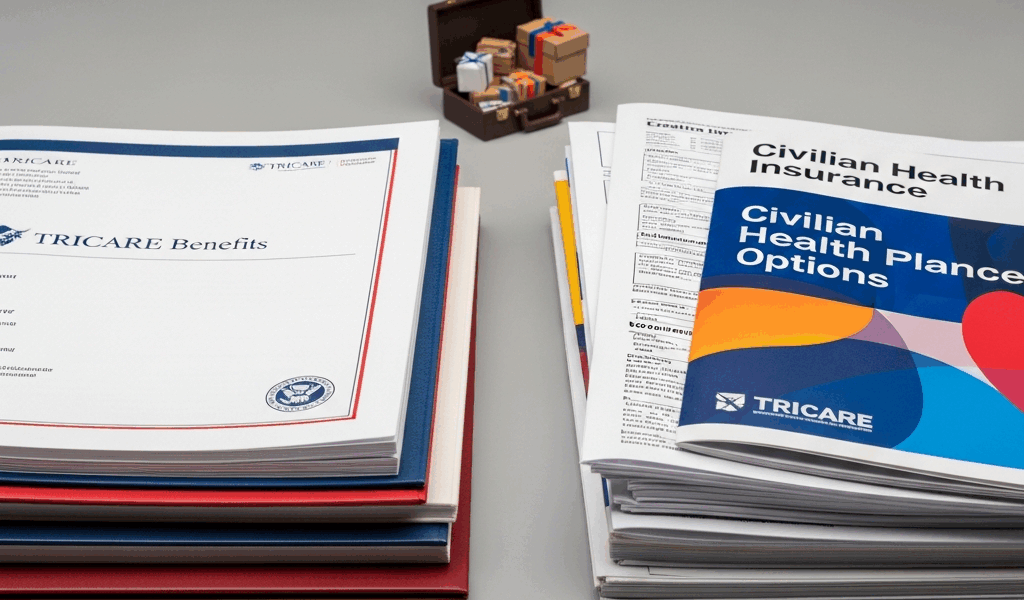
TRICARE vs Civilian Health Insurance — What Happens When You Leave the Military
Military healthcare is harder to figure out than it should be with all the misinformation flying around about what veterans actually face when they separate. As someone who out-processed at Fort Campbell in 2019, I learned everything there is to know about this transition the hard way. There I was in a fluorescent-lit room during my ACAP briefing — half-listening to some contractor blast through a PowerPoint slide about “transition resources” — genuinely believing I had a handle on things. I did not. First time I pulled up healthcare.gov and saw a $1,247 monthly premium for a family plan comparable to what I’d had for free, I laughed. Actually laughed. Then stared at the screen for about four minutes straight. Then called my wife in from the kitchen to confirm I wasn’t misreading something. This is everything I wish someone had handed me before that moment — real numbers, real options, honest takes on surviving the switch without torching your savings.
What TRICARE Actually Costs vs What You Will Pay as a Civilian
The math comes first. The math is what breaks people.
Active duty TRICARE Prime: $0 monthly premium. Zero. Primary care copays on base run $0, and even off-base referrals land somewhere between $12 and $30 a visit. Specialist visits track similarly. Prescriptions through a military pharmacy? Also $0. A bad year for a family on TRICARE Prime might run you a few hundred dollars total out-of-pocket — and that’s genuinely a rough year.
Now here’s what’s waiting on the other side.
The average employer-sponsored family health insurance premium hit roughly $23,968 per year in 2023, according to the KFF Employer Health Benefits Survey. Workers personally absorb about $6,575 of that annually — just for the premium. That’s $548 a month before you’ve stepped foot in a waiting room. And employer plans are typically the better deal. ACA marketplace plans, the ones you’re shopping if you don’t have employer coverage, often run steeper depending on where you live and what you earn.
Here’s a realistic breakdown for a family of four in Tennessee — which is exactly where I landed after separating:
- Bronze plan (ACA marketplace): ~$480–$620/month premium, $8,000–$9,450 family deductible before the plan meaningfully kicks in
- Silver plan (ACA marketplace): ~$780–$1,100/month premium, $4,000–$6,000 family deductible
- Gold plan (ACA marketplace): ~$1,100–$1,400/month premium, $1,500–$3,000 deductible
- Employer-sponsored family plan (mid-size company): $400–$700/month employee contribution, $3,000–$7,000 deductible
Those aren’t abstract figures. A Bronze plan with a $9,450 deductible means your family essentially pays cash for every appointment, every prescription, every lab draw until you’ve personally spent close to ten grand. Then — and only then — does the plan start helping. Healthy family that barely touches the healthcare system? You might squeak by. One emergency, though. One kid with a broken arm and an ER visit at 10pm on a Tuesday? You’re easily staring at $4,000–$6,000 from a single incident.
Don’t make my mistake. Frustrated by the sticker shock of Silver premiums, I grabbed the cheapest Bronze plan available to trim the monthly hit. That held up fine for eight months — right up until my daughter needed an unexpected imaging referral. Paid $1,800 out of pocket because we hadn’t touched the deductible yet. Expensive lesson, that one.
Honest side-by-side: TRICARE Prime for a family runs roughly $0 to $800 per year when you factor in copays. A comparable civilian Silver plan costs $9,000 to $15,000 per year combining premiums and out-of-pocket exposure. That gap — that’s your new healthcare tax for being a veteran.
TRICARE After Separation — Your Options
This part is what most people miss. Because between the moment you sign your DD-214 and the moment you land employer coverage or marketplace insurance, there’s a window — and specific programs exist to fill it. Most separating service members don’t know all of them.
TAMP — Transitional Assistance Management Program
But what is TAMP? In essence, it’s 180 days of continued TRICARE coverage after you separate — under certain conditions. But it’s much more than that; it’s breathing room when you need it most. Involuntary separations, reduction-in-force situations, qualifying discharges — those typically trigger eligibility. The coverage looks almost identical to what you had on active duty. Low premiums. Low copays. It buys time to figure out your next move without an immediate coverage gap punching you in the face.
Not everyone qualifies. Voluntary separations after a standard end-of-contract don’t automatically trigger TAMP. Pull up tricare.mil, verify your DD-214 characterization, and confirm eligibility before you assume you’re covered. Don’t assume.
CHCBP — Continued Health Care Benefit Program
CHCBP might be the best bridge option available, as the post-separation window requires reliable coverage fast. That is because it functions essentially like the military’s version of COBRA — purchasable for up to 18 months after separation, and in certain cases up to 36 months. Coverage mirrors TRICARE Select. The cost is real, though: as of 2024, CHCBP runs approximately $583/month for an individual and $1,620/month for a family. Steep. But compared to a high-deductible marketplace plan for a family that actually uses healthcare, the math can work in your favor. You have 60 days after losing TRICARE eligibility to enroll — that window closes fast.
VA Healthcare Eligibility
This is a separate lane entirely — we’ll get into it deeper in the next section. Short version: service-connected disability rating means you qualify for VA healthcare. No rating yet? You may still qualify based on income, service history, or other factors. Apply at va.gov/health-care/apply. Takes roughly 15 minutes online. Do it the week you separate, not six months later when you suddenly need it.
ACA Marketplace — Special Enrollment Period
Losing TRICARE counts as a qualifying life event, which opens a 60-day Special Enrollment Period on the ACA marketplace. Miss this window and you’re waiting until November’s Open Enrollment unless something else changes in your life circumstances. Income-based subsidies — premium tax credits — can significantly cut your ACA costs if your household income falls between 100% and 400% of the federal poverty level. Some states push that threshold even higher. Worth calculating before you assume marketplace plans are unaffordable.
Employer Coverage
Starting a new job? Your employer’s plan is almost certainly your best deal, even when the employee contribution stings. Employers absorb a meaningful chunk of the premium, and group plans typically deliver better network access and lower cost-sharing than comparable individual marketplace plans at the same price point. That’s what makes employer coverage endearing to us veterans trying to rebuild a financial foundation — someone else is subsidizing part of the bill.
VA Healthcare vs Private Insurance
These two systems aren’t interchangeable. Using them well means knowing what each one is actually built for.
Who Qualifies for VA Healthcare
Veterans who served on active duty and separated under conditions other than dishonorable generally qualify. Priority groups determine what you pay, if anything. Service-connected disability rated at 50% or higher? You pay nothing for VA care tied to those disabilities. Ratings between 10% and 40% carry modest copays. No disability rating? You may still qualify depending on income — the VA publishes annual income thresholds at va.gov. Applying costs nothing. If you served honorably and haven’t applied yet, there’s genuinely no good reason to keep waiting.
What VA Covers That Private Insurance Does Not
- Service-connected conditions — treated at little or no cost regardless of how expensive the treatment gets
- Mental health care — robust access to individual therapy, group programs, and crisis services without the bureaucratic runaround
- Prosthetics and certain adaptive equipment
- Comprehensive dental care for veterans with 100% disability ratings or specific qualifying conditions
- Long-term care and community living center access for eligible veterans
- Caregiver support programs under the MISSION Act
What Private Insurance Covers That VA Does Not
- Non-service-connected conditions for veterans in lower priority groups — VA may charge copays or limit access here
- Specialists of your choosing without referral bottlenecks — private plans generally move faster
- Maternity and obstetrics care — VA coverage in this area is improving, but remains inconsistent depending on location
- Dental care for veterans without a 100% rating — VA dental is extremely limited for most of us
- Vision care beyond basic screenings
- Coverage for family members — VA healthcare covers the veteran, full stop. Spouses and kids aren’t included
The practical answer for most veterans: use both. VA for service-connected care, mental health, and anything the VA covers at no cost to you. Private insurance for everything else — your family, specialists you want to see on your own schedule, conditions the VA won’t touch for free at your priority level. Running service-connected care through private insurance instead of the VA is essentially leaving money on the table every single time.
How to Budget for Healthcare After Military
Frustrated by three months of sticker shock after separating from 8 years of essentially free coverage, I rebuilt my entire understanding of how money and healthcare interact in the civilian world — using a legal pad, a calculator app, and a lot of coffee. Here’s the framework I actually use now.
Start With the Total Cost — Not the Premium
Most people compare health plans by monthly premium. Wrong number to lead with. The right calculation is: annual premium + estimated out-of-pocket costs + deductible exposure. A $400/month Silver plan with a $4,000 deductible and moderate family use might cost $7,200 in premiums plus $2,500 out-of-pocket — $9,700 total. A $650/month Gold plan with a $1,500 deductible might run $7,800 in premiums plus $1,000 out-of-pocket — $8,800 total. The Gold plan wins, even though the monthly number is higher. Run this math for your family’s actual usage pattern before you pick anything.
The HSA Strategy
End up on a High-Deductible Health Plan — which in 2024 means at least a $1,600 individual deductible or $3,200 for families — and you’re eligible to open a Health Savings Account. The 2024 HSA contribution limits sit at $4,150 for individuals and $8,300 for families, plus a $1,000 catch-up contribution if you’re 55 or older.
HSA money goes in pre-tax, grows tax-free, comes out tax-free for qualified medical expenses. After age 65, withdraw it for anything — it essentially becomes a traditional IRA at that point. Max your HSA every year you’re on an HDHP. Park it in a low-cost index fund inside the account — Fidelity’s HSA lets you invest in FSKAX with zero minimum. Let it compound for decades. Honestly, this is one of the best tax-advantaged vehicles available to veterans who no longer have TRICARE in their corner.
When to Use VA vs Private Insurance
First, you should build a simple personal decision rule — at least if you want to stop second-guessing every appointment. Service-connected condition? VA, every time, no exceptions. Running that through private insurance instead means you’re paying for something the government owes you. Acute non-service-connected care? Private insurance. Mental health — consider the VA seriously even if you have solid private coverage, because VA mental health providers understand military culture in a way that most civilian therapists, however well-meaning, simply don’t replicate.
Monthly Budget Numbers to Plan Around
Separating without a VA disability rating and without employer coverage lined up immediately? Budget conservatively:
- Health insurance premium (family, ACA Silver): $700–$1,100/month depending on state and household income
- Estimated monthly out-of-pocket costs (copays, prescriptions, labs): $100–$300/month for a family with moderate use
- Dental insurance (separate from medical on most plans): $40–$80/month for a family plan
- Vision: $20–$40/month, or pay out-of-pocket per visit and skip the plan
Total realistic healthcare budget before a disability rating or employer coverage: $860–$1,500 per month. That number lands differently when you’ve been paying nothing for years — apparently that’s the universal veteran experience when that first marketplace quote hits. Build it into your transition budget before you sign your separation paperwork, not after you’re already staring at the invoice.
The transition is survivable. The financial shock is real — but it’s workable once you see the complete picture and stop measuring civilian options against something specifically engineered to cost you nothing. Know your TAMP and CHCBP windows cold. Apply for VA healthcare the week you separate. Use your HSA like the tax shelter it actually is. And whatever you do — don’t grab a Bronze plan and bet that nothing goes sideways. Something always goes sideways.




Leave a Reply